
VIDEO UPDATE #6💧Beavers Know Best (Reviving Water Cycles Part II)
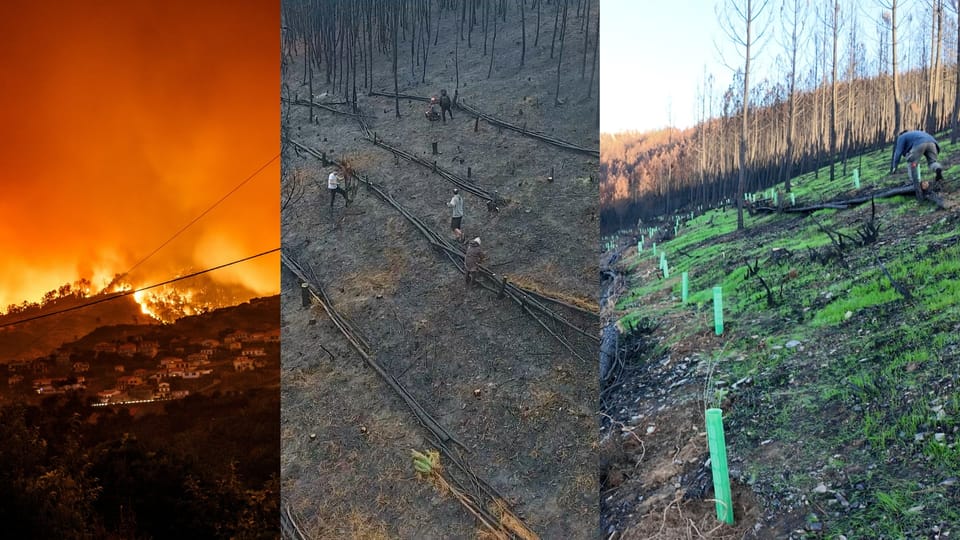
Healing landscapes isn’t just necessary—it’s joyful. Discover the interventions and attitudes that help us bring ecosystems back to life, with a little inspiration from nature’s best engineers.
In our previous video update, we dove into what’s really going on in our climate—and what it takes to actually heal it: living landscapes.
This update shows how we're learning to:
- put attitude first and technique second;
- build walls that don't block but give life;
- apply two essentials in all ecosystem revival work.
With thanks to the best of the best—Mrs and Mr Beaver, we present:
↡ A mini-documentary
↡ Credits, shout-outs & links to more
↡ A full documentary transcript
🎥 Mini-doc (14 min.)
Inspired?
🌏 Join us in reviving landscapes and communities:
📺 Receive inspiration, project updates, and ways to get involved » Subscribe to Miracle Project. No spam, unsubscribe anytime.
🌱 💚 Be part of a community and fuel our work » Become a member or see how membership works and what it supports
🤲 Help us make our next video » Become a patron
Learn more via the link or get in touch with us — we'd love to hear from you!
↡ Credits, shout-outs & links to more
↡ Full documentary transcript
❤️ Thanks and more
The wonderful team @WaterStories.com
for being such generous and impactful teacher-trainers—and for a heartfelt partnership. » WaterStories.com
The equally wonderful team @MaatschapWij.nu
One of the Netherlands’ only good-news-only platforms for a greener, healthier and more connected society, promoting our mission and sponsoring part of our video work. » MaatschapWij.nu
🌱💧 EcoAtivo & Centro Águas Vivas, for kick-ass collaborations in Central Portugal
🤲 Editing support: Sara Goudsblom » Simple Frames
🪇 Music used:
- Byzantine Knights by SashaBranislav Markovic
- Rio by 1000 Names
- Scattered Wave by Asura
- Divider by Chris Zabriskie
- Calming Music for Outdoor Relaxation by Viramiller
- Confusion by HoliznaCC0
More on this platform:
 Raymundo Resink
 Raymundo Resink
 Raymundo Resink

📜 Full documentary transcript
[00:00:00] Intro
So we're on a mission to build a regenerative community in central Portugal. A small-scale version of what the whole planet can be, reviving ecosystems and reinventing how we live, work, relate, and give.
In our previous two updates, we showed what so-called wildfires are really trying to tell us, and how to halt the vicious spiral of fires, droughts, floods, and desertification.
Or better said, to co-create lush and abundant ecosystems that are ever more complex and ever more life-giving, for all of life, including us humans.
So in this video, we're going to show the good side of human disturbance:
- some of the water cycle interventions we've been implementing,
- the baseline attitude we've been cultivating,
- and two things we're discovering as essential for any kind of ecosystem revival work.
[00:01:06] Only One Real Firefighter
Before we kick this off, why don't we just let nature do its thing?
We've seen firsthand, after the horrendous summer fires of 2025 here in central Portugal, the incredible resilience and regenerative power of nature.
But overgrazing, monoculture plantations, land mismanagement, and the dark side of political and economic forces are driving us more and more away from ecosystem stewardship and towards fighting fires, floods, and droughts.
Which is a shame, because as we said in one of our previous updates, 'When it comes to our so-called 'wildfires', I see only one real firefighter: nature, in all its glorious, lush, biodiverse, moisture-retaining brilliance.'
And this all starts with seeing ourselves not as separate from, but innately part of nature.
[00:02:05] Chapter 1. Baseline Attitude
One of the most important things we've been learning when it comes to analysing a piece of land that you want to help revive, is to not impose our human will, but to become receptive to what the land is trying to tell us it needs and wants.
To be like water, to walk on the land like water would flow on the land, to find direct and indirect evidence of the presence of water, whether above ground or below ground.
It's about practicing being a blank slate, so not thinking about what you think the land needs, but sensing — really using your senses, which includes your intuitive sense, to allow the land to dream through you, what it would like to see happen where.
When I walk the land like this, it really does start showing itself to me. Designing becomes less about going from top down, and more about listening.
Now this requires some practice, and depending on how busy the mind is, it might require a lot of practice, but anyone can do it.
We're not going into detail in this video; what we are going to do, is show some of the work that brings back water and life.
[00:03:23] Chapter 2. Interventions
One of the first things we did after the summer fires of 2025, was gather people around the community to build erosion retention lines on their lands.
We cut down burnt trees and we laid them on contour, so perpendicular to the water flow, securing them with stakes, creating barriers that slow the flow of water, help the water infiltrate, and create places to plant new trees.
Another intervention we've been practicing — and this is one of my favourites: beaver dams.
'We are here in a gully, and if we leave it like this, it's going to erode more and more and more. We have water falling down on the land here, and it goes straight down and it leaves the land very quickly. It doesn't have a chance to infiltrate, a chance to recharge the underground aquifer, and it's going to keep eroding more topsoil.
'So this will be filling up, and it's a leaky dam, so it's not designed to totally hold back the water; it's just designed to slow it down.
'But maybe at one point...
'Beavers maintain their dams, and so humans need to maintain these dams as well, by adding more organic matter over time. '
Is it moving?
— You're making a big difference.
Really?
— Yeah.
And they are amazing for lots of life to flourish here. And maybe, who knows, in a couple of years, we will have beavers here.
— 'Oh, you made that home for me?'
And then they'll be inviting their friends, and before you know it, this whole valley will be covered in beaver dams.
Now these interventions are pretty context-specific, but an intervention that you can do in many places, even in a very small backyard, is build a rain garden...
that takes water from where it's running off an impermeable surface, the roof of this barn.
We're going to help the water infiltrate, not only to recharge the ground water, but also to help the water get cleaned before it goes anywhere else, because lots of the water that is now running into rivers is coming from runoff sites like roads. It's pretty polluting, and we can quite simply do something about that.
Well, that's a nice surprise. That filled up incredibly quickly in just one night. The many good things that I'm seeing is that I now exactly know where I'm going to build the spillway out.
Okay, Rain Garden 1.0.
Deepest zone, and then the first level: mint and willow.
Second level: lemon balm.
And then third level: thyme, rosemary, lavender, and these two black elders I found growing here.
And so this whole rain garden: constructed, and vegetated, and mulched with everything that I found here.
So I've been away for a month and a half on a visit to the Netherlands, and coming back to the rain garden, this is what I'm discovering: huge amounts of rainfall, and it looks like this wall got oversaturated, and collapsed.
So now we have a rain garden with a mountain.
And to finish with the Rock Star of Water Cycle Revival: water bodies.
They are, the sexiest thing to have on your land. I think there's a human reason for that, because they're beautiful, they're nice to swim in, they just have a lot of aesthetic qualities.
But biologically speaking, they are incredibly good at hydrating the ground. You keep water in a single spot for longer, giving it even more time to sink into the soil. It attracts a lot of wildlife and insects, and it has a role in controlling temperature and humidity, so it can have massive local climate impacts.
[00:08:09] And... pre-intervention...
Building small-scale models of what you envision for on the land. Mini-landscapes that help you think with your hands. Okay, the model is almost done. We got a little bit pressed for time, and we started getting really stressed, and then our clients all showed up. 'Okay, let's make use of their presence and ask them if they want to help out to finishing the model.'
Marissa, what are you doing?
—I'm planting cactus.
And why are you planting cactus in this row?
—It's too rocky for regular trees.
Ah, okay.
Gulli, what are you doing?
—Um, I don't know.
Yeah, that's also a very important, uh, role.
— I just stick things.
A tree line on a terrace that we dug, slightly off contour, and then here, because the slope levels off —it becomes less steep, 'let's experiment with some swales.'
And we're going to see if they're going to hold, or whether they're going to cause a massive landslide and fill the pond with lots of organic muck.
Hello, Rona.
—Hello.
What animal are you?
—I'm a beaver.
A Beaver Dam Analogue, built by Rona the Beaver.
The water that overflows from the pond is going to go into that spillway, and then come down. And then here is a sediment trap, so any excess sediment that comes down with the water can get dumped here. And then this beaver dam is going to slow the flow and accumulate a lot of nice nutrients, and then a lot of life is going to start growing here.
Marco, do you want to explain what you built?
Okay. Maybe the visuals will explain for people who don't speak Portuguese. You can run off it and then jump into —I wouldn't do it yet.
That's all theory and model, and now we are going to put it to the test.
This is the spillway. When the, the pond overflows, it doesn't spill over the dam. At least that's the idea.
So it's now spilling over on that side, and that's not supposed to happen.
When I say go, you can go from gentle to torrential rain.
So we're getting a lot of erosion... oh my God.
What this is really telling me, is that it's so important to have vegetation all along the hill. Because this is now just really eroding everything.
The dam is being compromised, people.
—Oh, no.
So the little mini-ponds that are forming by the sediment traps, they're doing their work.
One of my biggest takeaways already from this whole process of building a model, is that it's really, really useful. Holding the material, working with the clay, and trying to get it to the right moisture to build a good compacted dam, building the slightly off-contour terraces and swales, building a mini beaver dam analogue, the spillways of the ponds... All of that stuff really helped me to see, 'Okay, so how do you do that? Where do you put what?'
Now I'm a kid again.
[00:11:08] Chapter 3. Two Essentials
The first is digging test slices.
—That's a jackpot.
No site analysis is complete if you don't know what's happening below the ground. Because you could be thinking it'd be really nice to dig a pond there, or there, or there, but you might just be digging something that's going to be a big hole, with a lot of time and energy wasted.
It was amazing for us to find out, in some of the sites where we'd been digging, that places we thought were going to be really suitable for a pond, actually turned out to be the worst places for a pond, and other places, where we hadn't thought a pond would be suitable, turned out to be the best places.
Just one day of getting a digger in, analysing the soil by hand and with mason jars, gave us a wealth of information, and a much, much better design.
The second essential: coming together as a community.
We can revive ecosystems on our own little plots of land all we want, but everything and everyone is connected. So if we really want to make a positive contribution to the health of the nature around us, we need to start collaborating not only with that nature, but also with the people in it.
Member discussion